
Does the thought of giving critical feedback leave you in a cold sweat?
When it comes to delivering feedback, professor Brené Brown hits the nail on the head.
“Clear is kind, unclear is unkind.”
Holding back from sharing what you’re really thinking and feeling not only breeds resentment, but also withholds crucial information that will help the person receiving it learn, grow and improve.
So how do we ensure that the feedback we’re giving is not only specific but helpful and consistent too?
Say hello to the COIN method. Your new best friend for delivering feedback in a supportive, meaningful and actionable way.
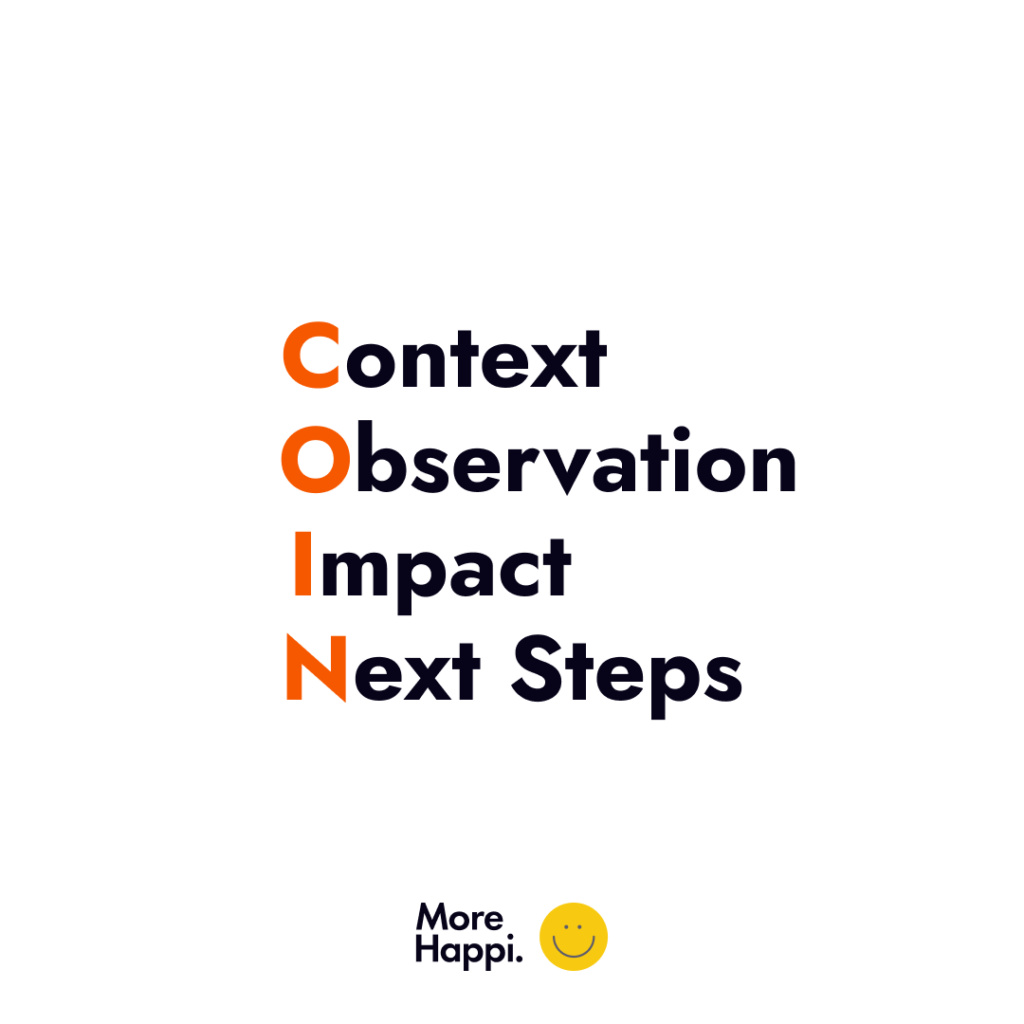
How it works:
C-context:
Share some background information about the situation or behaviour you’re giving feedback on.
This could include the date, time, and location of the event, as well as any relevant information about the people involved.
For example: “In our project management process, meeting deadlines is essential for our team’s success and for maintaining client trust.”
O-observation:
Describe what you observed, without judgment.
Focus on specific behaviours and actions – the facts – rather than making personal, vague and/or general statements about the person’s character or personality.
For example: “Last week, you missed the final deadline for submitting the project, which caused some delays in our timeline.”
I-impact:
Explain how the person’s behaviour or actions impacted you, others, or the team. Be specific about how the behaviour made you feel, and how it affected your work or the team’s performance.
For example: “Because of the delay, other team members had to adjust their schedules, and we had to reschedule a client presentation, which affected our project momentum and may impact client satisfaction.”
N-next steps:
Offer suggestions for how the person could improve their behaviour or actions. Be specific about what you would like to see them do differently.
For example: “Moving forward, let’s set a check-in a few days before the deadline to address any potential roadblocks early. Also, if you think you might not meet a deadline, please let us know as soon as possible so we can strategize as a team.”
Remember, feedback is a two-way street. Be open to receiving feedback from others, and be willing to make changes based on their feedback.
Bonus step:
Put on your coaching hat, and ask questions to help the person you are giving feedback to reflect on their behaviour and make changes tailored to them.
– What were you thinking and feeling when you did that?
– How did your behaviour impact others?
– What could you have done differently?
– What are you going to do differently in the future?
Three ways to make delivering critical feedback a walk in the park (for everyone) and 10x more effective:
1. Environment is everything.
- To achieve the best outcome, when and where will you have the conversation?
- Will the feedback be better received in person, virtually, or over the phone? Where will the receiver feel most comfortable and primed to digest it? If you’re not sure, just ask.
- Somewhere away from the team, with minimal distractions is a good starting point too. Your full attention is vital.
2. Be direct, but don’t be a d***
Jotting down what you need to say and doing a test run beforehand (a More Happi coach can help), will ensure that your feedback lands thoughtfully and compassionately.
When in doubt, use the COIN model above. You can even use an AI tool like Claude or Chat GPT to help you restructure your feedback into the COIN framework.
3. Give it time (if needed).
- No matter how helpful feedback is, it can still be hard to process.
- Simply asking, “Would you like to unpack this together now, or do you need some space first?“ can help the individual feel like their needs are respected.
- You can always encourage them to book a coaching session (and one for you too while you’re at it!).
Why coaching is a game-changer for building high-performing teams
For forward-thinking organisations, coaching stands out as a scalable, impactful solution. Unlike mentoring, which relies on experienced professionals within the organisation, or therapy, which is clinical in nature, coaching is flexible and adaptable to a wide range of business contexts.
By offering coaching across your workforce, you:
- Empower employees to become more self-sufficient problem-solvers
- Strengthen resilience and adaptability in times of change
- Create a culture of continuous learning and growth
At More Happi, we make coaching accessible for everyone, not just the C-suite. Our on-demand coaching platform enables organisations to offer one-to-one coaching at a fraction of the cost of traditional coaching platforms. Loved by start-ups, scale-ups and enterprise businesses.
Ready to see the impact of coaching in your organisation?
Book a call with More Happi today and discover how our coaching platform can transform the way your people learn, grow, and thrive.
Already a More Happi member?
Every framework in this article works better with a thinking partner. A More Happi Coach can help you process a recent setback, prepare to lead through a specific change, or address a workload gap before it becomes a bigger problem, whichever of these you’re facing right now.
More Happi members can book a coaching session.